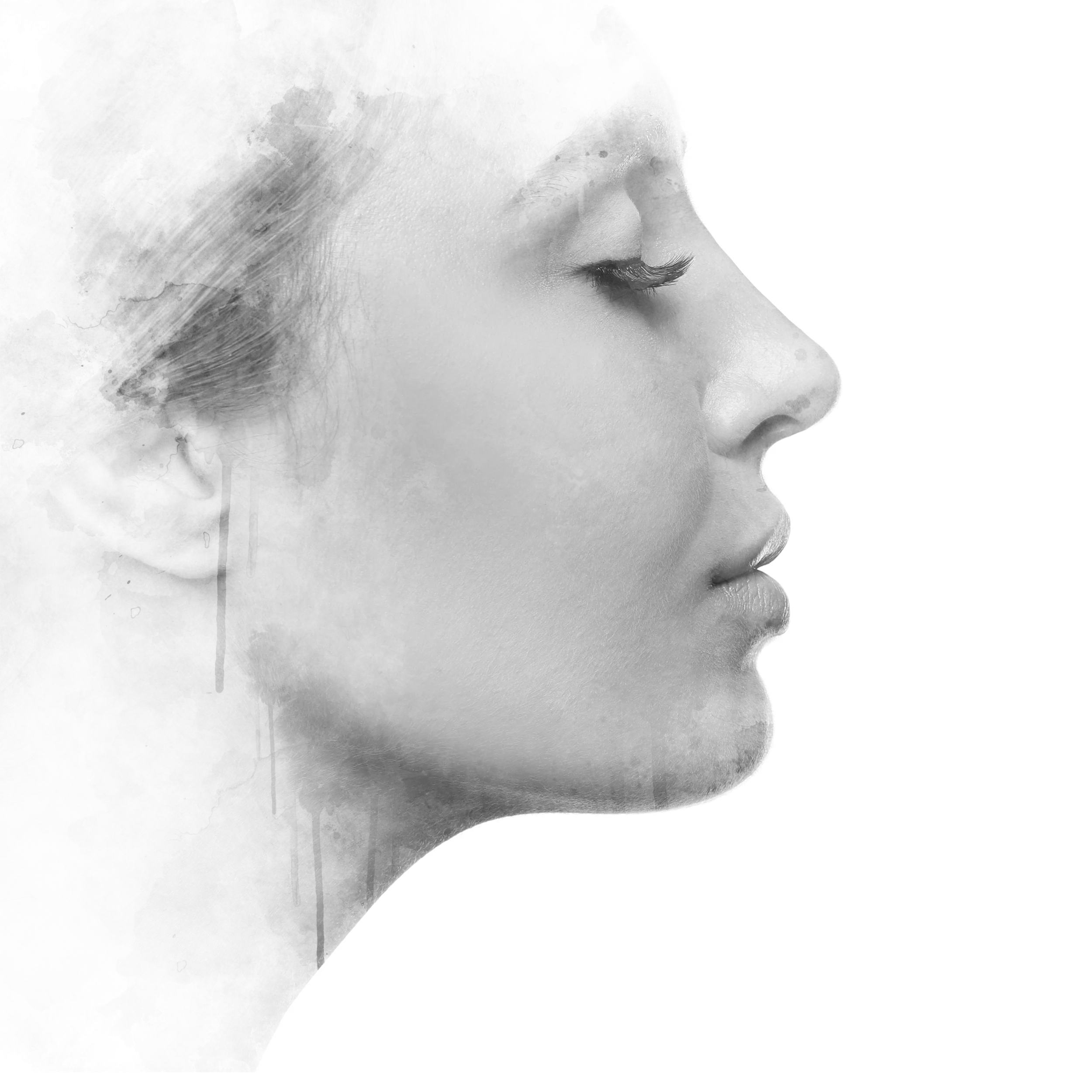
Rhinoplasty
Rhinoplasty is widely regarded as the most technically demanding operation in aesthetic surgery. It is millimetric, the final result takes a year to appear, and it deserves a surgeon chosen carefully.
The one thing to understand before anything else
There are three reasons rhinoplasty is so demanding, and understanding them will make you a better-informed patient. None is a reason to avoid the operation — they are reasons to choose carefully and to expect a slow result.
- 1
It is millimetric
The difference between a good result and a disappointing one is often one or two millimetres. There is very little margin.
- 2
You cannot see the final result for a year
The nose swells and de-swells over months. What you see at two weeks, at three months and at twelve months are three different noses. Patients who panic at week three usually end up happy at month twelve.
- 3
Revision rates are meaningfully higher than in most procedures
Published revision rates for rhinoplasty across the profession generally sit in the range of 5–15%. Any surgeon telling you revision never happens in their practice is not describing reality.
Open or closed rhinoplasty?
Two approaches, chosen by what your nose requires rather than by preference.
| Closed (endonasal) | Open (external) | |
|---|---|---|
| Incisions | Entirely inside the nostrils | Inside the nostrils plus a small incision across the columella |
| External scar | None visible | A small columellar scar that typically fades to near-invisible |
| Surgical visibility | Limited — the surgeon works with less direct view | Full direct view of the nasal framework |
| Best suited to | Hump reduction, modest tip refinement, straightforward cases | Significant tip work, structural grafting, revision surgery, asymmetry correction |
| Swelling | Generally settles somewhat faster | Slightly more prolonged tip swelling |
On the term “scarless.” Closed rhinoplasty avoids a visible external scar — that part is accurate — but incisions are still made inside the nose and internal healing still occurs. Which is better? Neither. The right choice depends on what your nose needs. A surgeon who performs only one technique will recommend that technique regardless — which is a reason to ask.
What rhinoplasty can — and cannot — do for the face
On facial harmony. The nose is not assessed in isolation. Chin projection, in particular, strongly affects how prominent a nose appears — a patient with a modest chin can appear to have a larger nose than they do. Occasionally the more effective change is not to the nose at all.
On ethnic rhinoplasty. Patients from different backgrounds have different nasal anatomy — skin thickness, cartilage strength and bone structure vary meaningfully. Good rhinoplasty refines a nose while preserving the features that make it consistent with your face and heritage. The objective is not a single standardised nose shape.
- Dorsal hump — a bump along the bridge
- Tip shape — bulbous, drooping, over-projected or under-projected
- Nasal width — the bridge or the nostril base
- Deviation — a nose that is crooked or asymmetric
- Profile balance — the relationship between nose, chin and forehead
- Breathing — a deviated septum or collapsed nasal valve, where present
Are you a candidate for rhinoplasty?
You are likely a good candidate if
- Your facial growth is complete — generally 17+ for women, 18+ for men
- You are in good general health with no uncontrolled conditions
- You are a non-smoker, or willing to stop at least four weeks before and after
- You can articulate what specifically bothers you about your nose
- Your expectations are proportionate — refinement of your nose, not replacement with someone else’s
- You understand the result takes up to twelve months to fully appear
- You can take 7–10 days away from work
You are probably not a candidate if
- Your facial growth is incomplete. Operating too early risks the result changing as growth continues.
- You cannot describe what bothers you, or your concerns shift substantially between consultations.
- You have body dysmorphic disorder, or features suggestive of it. Rhinoplasty has a well-documented association with BDD, and surgery does not resolve it — it commonly makes distress worse. A responsible surgeon screens for this and declines.
- You expect a specific celebrity’s nose. Your skin thickness, cartilage and bone set the ceiling; thick skin in particular limits achievable definition.
- You smoke and will not stop. Smoking impairs healing of the delicate nasal tissues.
- You have unrealistic expectations about timeline. If you need to look perfect for an event in six weeks, this is not the right time.
If Dr. Valente concludes you are not a candidate, he will say so and explain why. In rhinoplasty specifically, declining the wrong patient is one of the most important things a surgeon does.
Three principles in rhinoplasty
- 1
Structure before reduction
Older technique relied heavily on removing tissue. Contemporary practice preserves and reinforces structure — an over-reduced nose can collapse or develop breathing problems years later.
- 2
The nose must work, not only look right
Aesthetic changes that compromise the airway are a failure regardless of appearance.
- 3
Conservative over dramatic
A nose that draws attention to itself as surgical is a poor result, however precisely executed. The aim is a nose that looks like it was always yours.
“Patients often arrive with a photograph. I explain that their skin thickness and cartilage determine what is achievable, not the photograph. That conversation is not what they want to hear, and it is the reason they are happy a year later.”
Why patience matters here more than anywhere
| Period | What to expect |
|---|---|
| First 48 hours | Congestion, mild discomfort, swelling around the eyes. Head elevated. Bruising begins. |
| Days 3–5 | Bruising at its most visible. Swelling peaks. The hardest few days emotionally. |
| Day 7 | Splint removed. The nose will look swollen and the tip firm — this is not the result. |
| Days 7–10 | Most return to work. Bruising largely resolved or coverable. |
| Weeks 2–4 | Obvious swelling settling. You will start to see a shape. No contact sport, no glasses resting on the bridge. |
| Weeks 6–8 | Strenuous exercise usually permitted. Nose looks broadly normal to others. |
| Months 3–6 | Refinement continues. Most swelling resolved except at the tip. |
| Months 6–12 | Tip swelling gradually resolves. The final result. |
A specific warning about week three. Almost every rhinoplasty patient has a difficult period between weeks two and six, when the splint is off, swelling is still substantial, and the nose does not look like what they expected. This is normal and universal — not a sign the operation failed. Thick skin takes longer: tip definition can take the full twelve months.
Risks and complications — stated honestly
Common and expected: swelling, bruising, congestion, temporary numbness at the tip, mild discomfort.
Uncommon: prolonged swelling, asymmetry, small contour irregularities, persistent numbness, difficulty breathing during healing, an unsatisfactory aesthetic result requiring revision.
Rare but serious: infection; bleeding requiring intervention; septal perforation; anaesthetic complications; permanent breathing impairment; and in very rare cases, skin necrosis over the nasal tip.
On revision, honestly. Rhinoplasty has a higher revision rate than most aesthetic procedures — published rates generally sit around 5–15%. This is a function of how technically demanding the operation is and how unpredictable individual healing can be. It should be discussed openly before surgery, including who bears the cost and how long you must wait — usually at least twelve months — before revision can be considered.
Non-surgical rhinoplasty — a note
Some Dubai clinics offer “non-surgical” or “liquid” rhinoplasty using dermal fillers. What it can do: camouflage a small dorsal hump by adding volume above and below it, or slightly lift a drooping tip — results last months, not years. What it cannot do: make a nose smaller. Filler adds volume; it cannot reduce. If your concern is size, filler is the wrong tool.
A safety note worth stating. The nose has a blood supply that makes filler injection there higher-risk than most facial areas. Complications, though rare, can include skin necrosis and — very rarely — vision loss. If you pursue this, it should only be with a practitioner experienced specifically in nasal filler and equipped to manage a vascular complication. Dr. Valente performs surgical rhinoplasty; if a non-surgical approach genuinely suits your concern better, he will tell you.
Honest pricing and what should be included
Published Dubai market figures for rhinoplasty generally range from approximately AED 25,000 to AED 45,000, with revision rhinoplasty typically costing more than primary surgery.
What should be included: surgeon’s fee, anaesthetist’s fee, facility fee, pre-operative investigations, splints and dressings, and all routine follow-up.
Worth stating plainly. Rhinoplasty is the procedure where choosing on price carries the highest penalty. Revision rhinoplasty is harder than primary surgery, costs more, and the achievable result is usually less good than if the first operation had been done well. Ask specifically what the revision policy is before you commit.
On functional surgery and insurance. Where surgery is genuinely required to correct a breathing problem — a deviated septum, for example — some UAE policies provide partial coverage. Purely aesthetic rhinoplasty is not covered. Where a procedure combines both, insurers typically cover only the functional portion.
Rhinoplasty in Dubai — book an honest assessment
A consultation with Dr. Augusto Valente includes a candid assessment of whether surgery is right for you — including being told if it is not. You will not be asked to decide on the day.
- Licensed hospital · dedicated anaesthetist
- English & Portuguese
- Structured follow-up
Rhinoplasty — frequently asked questions
Everything you want to know about LipoHP — the original High Performance Liposuction — body sculpting, ab etching, waist sculpting, recovery and booking your consultation.
Looking for more? See the complete FAQ.