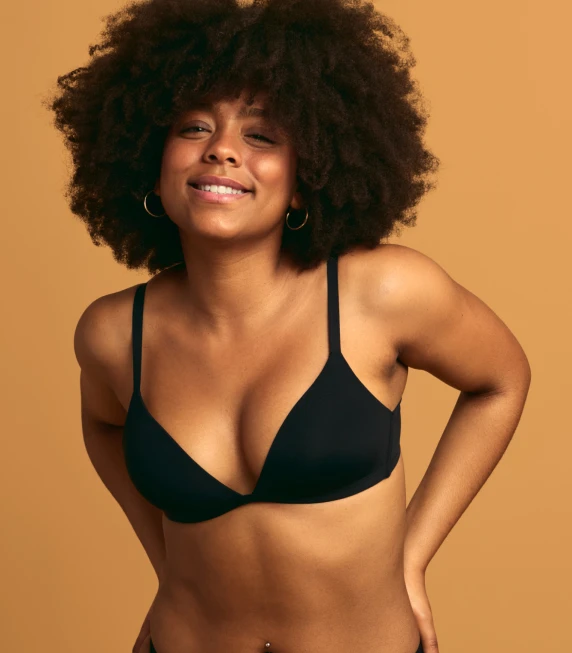
You cannot reliably tell from a photograph whether someone has had breast surgery — and neither can the websites that claim to. A change in breast appearance between two photographs has at least a dozen possible explanations, most of which are not surgical, and a photograph contains no information that distinguishes between them.
That is the honest answer to the question, and it is worth understanding properly if you are considering surgery yourself. What the internet presents as evidence of a procedure is usually evidence of a different bra.
Can You Tell If Someone Has Had Breast Implants From a Photograph?
No. There is no visual feature in a photograph that reliably identifies surgery, because every feature people cite as a giveaway — upper fullness, roundness, spacing, projection — also occurs naturally and can also be produced by clothing, posture and lighting.
Surgeons examine patients in person. Assessment involves palpation, movement, measurement and history, and even then a well-performed augmentation on a patient with good tissue coverage can be difficult to identify visually. A journalist comparing two red carpet photographs has none of that.
The pages that publish before-and-after celebrity comparisons are not making a clinical assessment. They are guessing from images, and then presenting the guess as analysis.
In short: changes in breast appearance between photographs may result from weight change, pregnancy, breastfeeding, hormonal changes, ageing, posture, camera angle, lighting, garment construction or image editing. No visual feature reliably distinguishes surgical from non-surgical change, and clinical assessment requires in-person examination including palpation, measurement and medical history.
What Changes Breast Appearance Without Any Surgery
Breast appearance changes throughout adult life for many reasons, and most women’s breasts look measurably different in photographs taken years apart. Before concluding that surgery explains a difference, consider everything else that does.
Physiological change:
- Weight gain and loss — breast tissue includes fat, so body weight changes breast volume
- Pregnancy and breastfeeding — both change volume, shape and skin, often permanently
- Hormonal fluctuation — including across the menstrual cycle and with contraception
- Ageing — skin elasticity and tissue support change over decades
- Muscle development — training changes the chest wall beneath the breast, which changes how it sits
Photographic and styling change:
- Bra construction — a structured, padded or push-up garment changes shape dramatically
- Tape, adhesive support and built-in garment structure — standard in event dressing
- Posture — arm position and how the shoulders are held
- Camera angle and lens — a lens close and low produces a different breast shape than one further back
- Lighting direction — side lighting creates shadow that reads as cleavage and projection
- Retouching — routine in published photography
Any one of these can produce a difference between two images that looks like a procedure. Several together reliably do.
Why Celebrity Photographs Are Produced, Not Recorded
A red carpet photograph is a manufactured image, and the manufacture is professional. A stylist selects a garment engineered for that body. Structure, tape and padding are built in. Lighting is positioned to flatter. The subject has been photographed thousands of times and knows precisely how to stand. Several hundred frames are taken, one is selected, and it is edited before release.
None of that is deceptive — it is the normal production of a public image. But it means the photograph records what a team produced on one evening, not what a body looks like.
The consequence for anyone considering surgery: a surgeon cannot reproduce a result that was not produced by surgery.
What the People in Those Photographs Have Said
The women whose images circulate as aesthetic references have been direct about how unrealistic the standard is.
Scarlett Johansson, discussing the appearance expectations placed on young actors in Hollywood in the early 2000s, described the standard as unachievable and said it left little room for individuality. Speaking separately about public commentary on her body during pregnancy, she said she wanted to have her own feelings about her changing body without other people telling her how they saw it — a comment about appearance commentary generally rather than about any procedure.
What none of these women have done is confirm the speculation published about them. Pages asserting that a particular public figure has had breast surgery, or a breast reduction, are stating something the person has not stated. This practice does not publish claims about anyone’s medical history without their word for it.
Is There Really a “Perfect” Breast Shape? What the Research Says
There is published plastic surgery research examining what proportions people consistently rate as attractive in a breast, and it produces measurable findings — but “consistently rated attractive” is not the same as “correct,” and the research does not describe a shape every breast should be.
The most cited work in this area analysed breast proportions and identified a characteristic relationship between the upper and lower portions of the breast, together with a slight upward angle of the nipple, in breasts rated most aesthetically pleasing.
Two things follow, and the second matters more.
First, the research is useful to surgeons. It gives a vocabulary for discussing proportion — upper pole fullness, lower pole projection, nipple position — which is more precise than cup sizes for planning an operation.
Second, it is frequently misused in marketing. A statistical preference derived from rating studies is not a standard any individual breast should be measured against, and applying one target proportion to every patient is precisely how results end up looking uniform and operated on. Published proportions describe an average preference. They do not describe your body, and they were never intended to.
Where a research finding is quoted at you as a target, the question to ask is whether the surgeon is describing your anatomy or a formula.
Why Celebrity Breast Reduction Speculation Misses the Point
Speculation about whether a public figure has had a breast reduction attracts attention, but it obscures why women actually have the operation — and the real reasons are far more compelling than the gossip.
Breast reduction is one of the more consistently satisfying operations in plastic surgery, and it is frequently performed for physical symptoms rather than appearance. Women seek assessment for persistent neck, shoulder and back discomfort, grooving from bra straps, skin irritation beneath the breast, difficulty with exercise, and difficulty finding clothing that fits.
Framed as celebrity gossip, reduction becomes a question of whether someone changed how they look. Framed accurately, it is often a question of whether someone stopped being uncomfortable.
If large breast size is causing you physical symptoms, that is a reason to seek assessment regardless of what anyone famous may or may not have had done. Detail on the operation is on the breast surgery in Dubai page.
What Breast Surgery Can and Cannot Change
Breast surgery works within your existing anatomy, and five factors set the boundaries of what is achievable. None of them can be changed by a reference photograph.
- Breast base width — how wide an implant can sit without extending beyond the natural breast footprint
- Nipple position and degree of ptosis — whether volume alone will help, or whether the tissue also needs repositioning
- Chest wall and sternum — where the breasts sit and how much natural separation exists between them
- Soft-tissue coverage — how natural the result looks and feels, and whether implant edges may become visible
- Skin quality and elasticity — how the tissue accommodates volume and how the result holds over time
The second factor is the one patients most often overlook, and it changes the operation. Where the nipple sits low relative to the fold beneath the breast, adding an implant makes the breast larger without making it higher — and can make descent more obvious rather than less. In that situation the relevant assessment is a lift, or a lift combined with an implant, not an implant alone.
The distance between the breasts illustrates the same principle. It is determined largely by sternum width and where the breast tissue begins on the chest wall, and no breast operation narrows the sternum. A reference image showing close-set breasts on a narrow chest cannot be reproduced on a wide one. This is covered in the guide to wide-set breasts and cleavage.
How to Use Reference Photographs Properly
A reference photograph is genuinely useful when it shows a body with a similar starting point to yours. Anatomy predicts your result far more reliably than an aesthetic ideal does.
A useful reference image shows:
- A similar frame — height, build, shoulder and rib cage width
- Similar starting breast volume, base width and nipple position
- Similar skin quality
- Ordinary lighting, standing normally
- No structured, taped or padded garment
- A stated interval since surgery, long enough for the result to have settled
A misleading reference image has:
- A different body type
- Professional lighting and styling
- Engineered clothing
- An arched or turned pose
- No way of knowing whether surgery was involved at all
Bring the Second Photograph Too
The image patients rarely bring is the more informative one: a result they want to avoid.
“I don’t want to look like this” defines the boundary of an acceptable outcome far more precisely than describing the target. Two patients can point at the same desired result and mean opposite things — one wants noticeable fullness, the other wants nobody to notice at all. The avoid-image separates them immediately.
If you take one thing from this article into a consultation, take that.
Considering Breast Surgery in Dubai?
Dr. Augusto Valente assesses breast and chest anatomy by measurement and builds the plan from what is there — including advising when a requested result is not achievable in a particular body, or when surgery is not indicated at all. You will find detail on the procedure and can read more about Dr. Augusto Valente before you book.
This article is general information and is not medical advice. Results vary between individuals. All surgery carries risk. A personal consultation and clinical examination are required before any treatment recommendation.
Written by Dr. Augusto Valente Plastic surgeon in Dubai