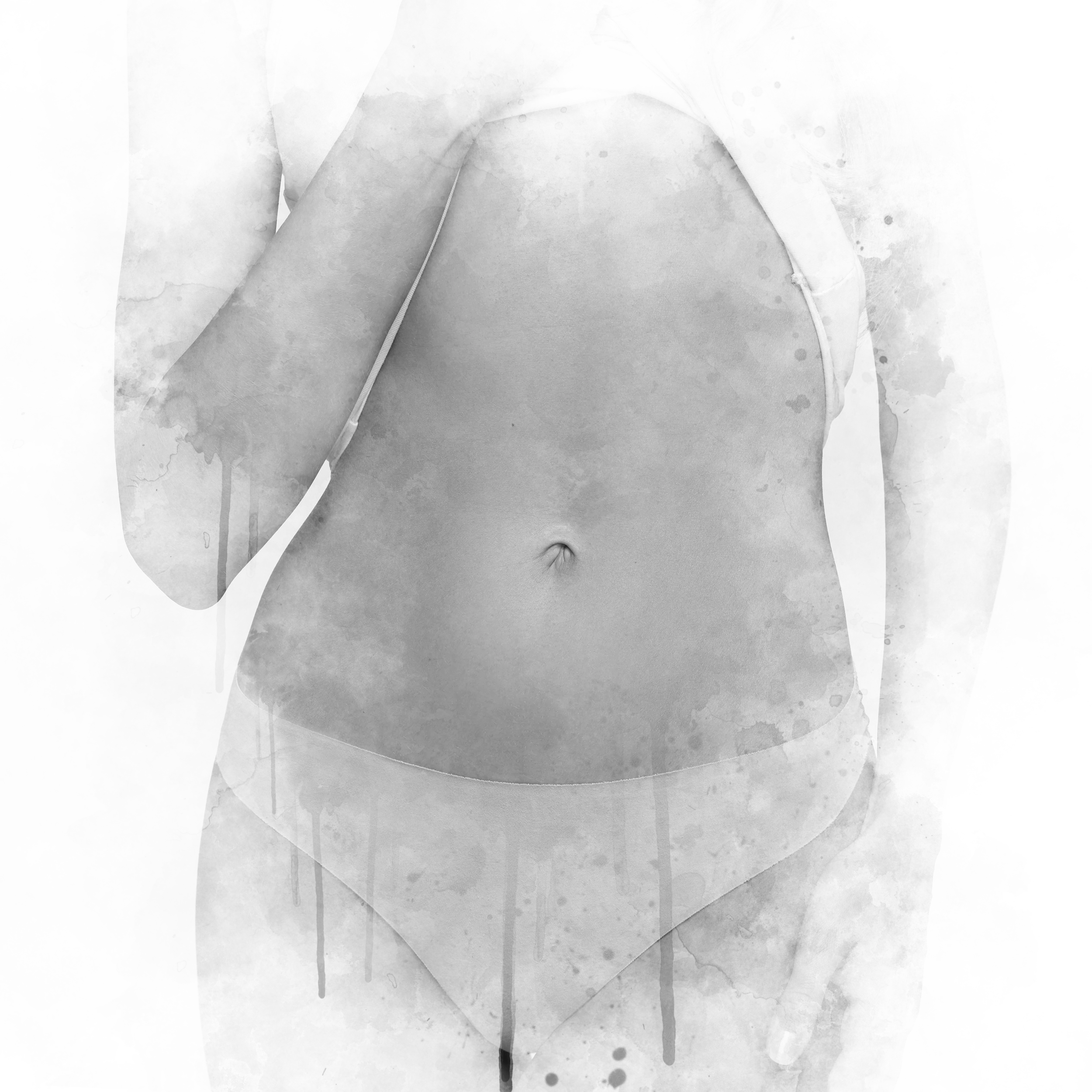

Some fat remains even when weight is stable and training is consistent. This is localised fat, and it does not respond to diet and exercise in the way that generalised weight does. When the weight has stopped moving and the shape has not, the remaining problem is usually distribution rather than quantity.
Answer in 30 seconds
- Stubborn fat is localised fat that stays when overall weight is already stable.
- Diet and training reduce weight. They do not decide where fat sits.
- Liposuction is not a weight loss operation. It typically removes only about 2 to 5 kg.
- Fat is not the only possible cause. Loose skin and separated abdominal muscles can look similar from outside.
- Which one applies is decided by examination, not from a photograph.
Consultations at The Offices 2, One Central, 6th Floor, Dubai.
What is stubborn fat, and why does it resist diet and exercise?
Stubborn fat is localised fat that remains in a specific area after overall weight has stabilised. Diet and training reduce how much fat the body carries. They do not determine where the remaining fat sits.
“You train, you eat well, but your belly or waist still doesn’t change. Sometimes stubborn fat stays even when your weight is stable.”
This is why two people at the same weight can have very different shapes, and why the last area to change is rarely the area someone most wants to change.
Can exercise target fat in one area?
No. Training builds muscle in the area being trained. It does not direct the body to reduce fat in that same area.
This is the single most common misunderstanding behind months of frustration. A person doing daily abdominal work is strengthening the muscle underneath the fat. Whether the fat above it reduces is decided by overall energy balance and by individual distribution, neither of which responds to the choice of exercise.
Is my problem fat, or is it something else?
An abdomen that still protrudes after weight loss may be protruding because of fat, because of loose skin, because of separated abdominal muscles, or because of more than one of the three at the same time.
These look similar from the outside and they have completely different answers. Fat responds to liposuction. Loose skin does not. Separated abdominal muscles, called diastasis, do not.
Read more on liposuction or tummy tuck, which covers how the three are distinguished at examination.
What does body contouring actually change?
Body contouring changes the shape and proportion of an area rather than the number on the scale.
“With body contouring and LipoHP, I look at the abdomen, waist, sides and back together to improve the overall shape and balance.”
Treating the abdomen in isolation is what produces a result that looks corrected rather than natural. A waist reads as narrow in relation to what sits above and below it, which is why the whole torso is planned together. That is how body contouring in Dubai and LipoHP in Dubai are planned.
Will surgery change my weight?
No. Liposuction typically removes only about 2 to 5 kg, and often less. It changes shape, not weight. Full detail on the numbers is in the article on how many kg you lose with liposuction.
“With liposuction, think about shape, not weight.”
If the goal is to move the number on the scale, this is the wrong operation. If the goal is to change a shape that has not responded to consistent training at a stable weight, it is the right conversation to have.
When is it worth having a consultation?
A consultation is worth having when the weight has stopped moving and the shape has not, and you want to know which of the possible causes is actually yours.
“If this is something you’re struggling with, book your consultation and let’s see what can work for your body.”
Request a consultation to find out which of the possible causes is yours.
Written by Dr. Augusto Valente Plastic surgeon in Dubai