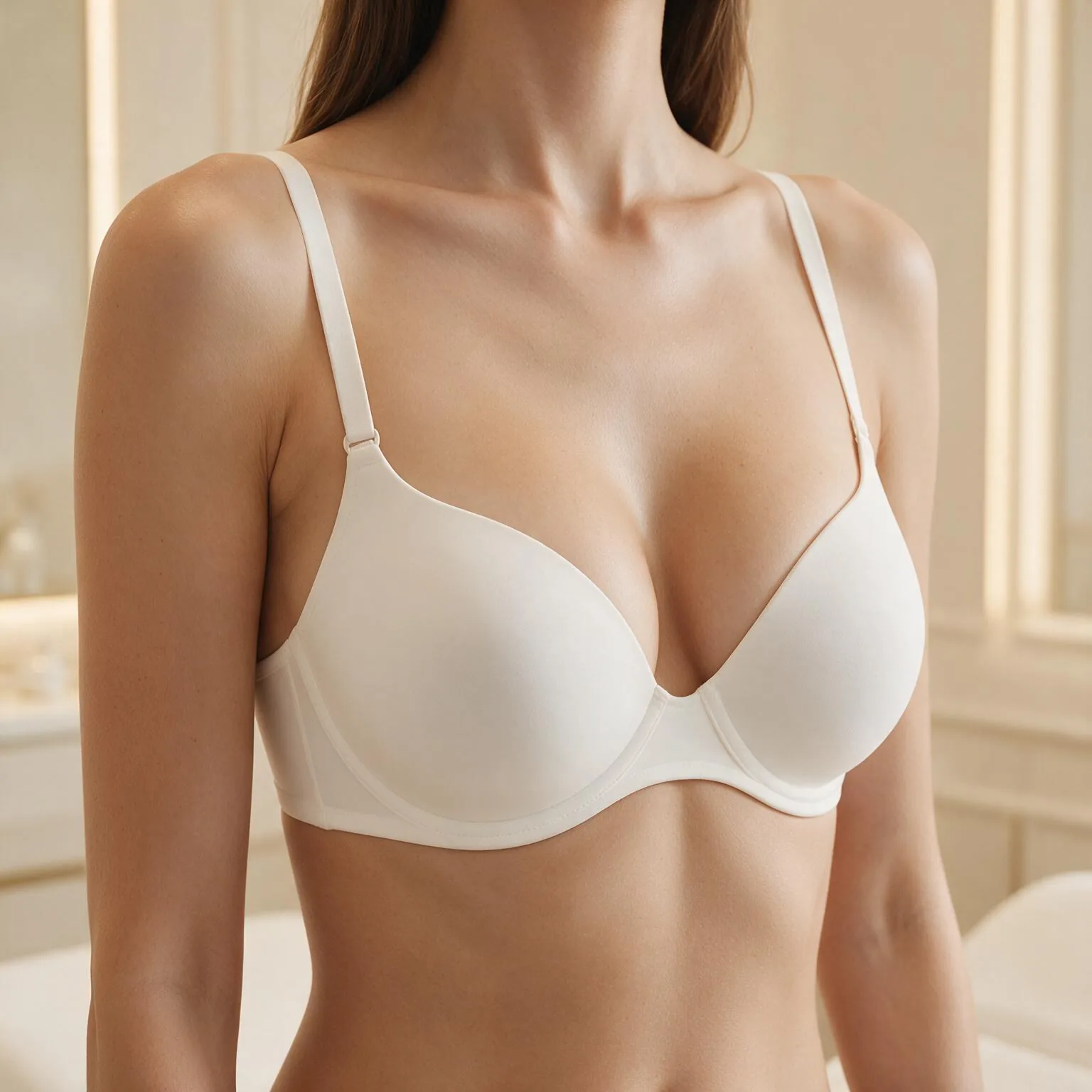
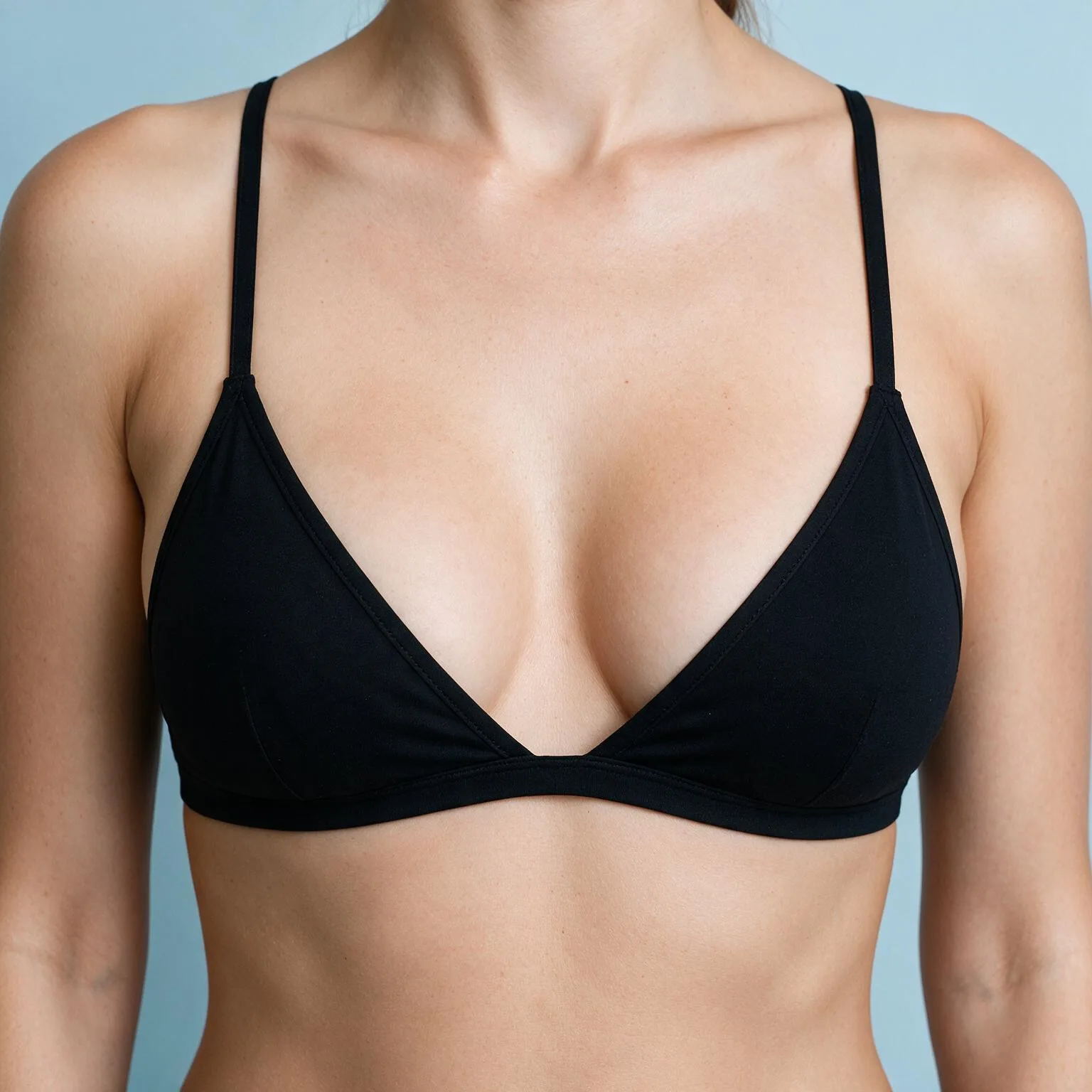
Wide-Set Breasts
Wide-set breasts are a normal anatomical variation, not a deformity. Surgery may add fullness toward the inner breast and make cleavage more visible but no operation can safely narrow the sternum or guarantee that the breasts will touch.
The Offices 2, One Central, 6th Floor, Dubai, UAE
Wide-set breasts, answered in seven lines
- Wide-set breasts are normal. Chest and breast anatomy varies between women in the same way height and foot size do.
- Breast spacing and cleavage are not the same thing. Spacing is where the breasts sit; cleavage is visible inner fullness.
- The sternum sets the limit. No surgery narrows the sternum or relocates the natural breast footprint across it.
- Implants can add inner fullness and make cleavage more visible within the boundaries of your own anatomy.
- Bigger implants do not produce better cleavage. Implant width and how it matches your breast base matter more than volume.
- Forcing implants too close together is a recognised complication risk, not a technique.
- No treatment is a legitimate outcome. Many women who read this page do not need surgery.
What are wide-set breasts?
Wide-set breasts describe a greater-than-average distance between the two breasts across the chest, so that there is a wider central gap and often less natural cleavage. It is an anatomical variation not a disease, a deformity or a sign that anything has gone wrong. The term appears mostly in bra fitting, lingerie marketing and cosmetic surgery advertising; it is a descriptive phrase rather than a clinical diagnosis.
Spacing and cleavage are different things. Breast spacing describes where the breasts physically sit on the chest wall. Cleavage describes the visible fullness and shadow between them which depends on volume, tissue distribution and support as much as on position. A woman with genuinely wide-set breasts may still create cleavage in a supportive bra, while a woman with normally positioned breasts may have little cleavage because there is limited volume toward the inner breast. Confusing the two leads to the wrong expectation of surgery: adding volume can change cleavage, but nothing changes where the breast begins on the chest wall.
Why this is usually normal. Chest and breast anatomy varies naturally between women, in the same way that height, hand size and shoulder width vary. There is no correct distance between the breasts. Comparison drives most of the concern lingerie photography, swimwear marketing and social media are heavily weighted toward one narrow presentation of the female chest, often achieved with structured bras, adhesive tape, posing, lighting and editing rather than anatomy.
The space between the breasts is determined by anatomy that is not under your control:
- Sternum width the breastbone at the centre of the chest, which sets the central distance
- Rib cage shape and chest wall curvature a broader or more rounded chest changes how the breasts sit
- Breast base position where the breast footprint begins and ends on the chest wall
- Medial tissue volume how much breast tissue sits toward the inner side of each breast
- Nipple and breast orientation whether the breasts point forward or somewhat outward
- Inframammary fold position where the crease beneath the breast sits, anchoring the lower breast
- Skin and tissue characteristics elasticity, thickness and how the tissue is supported
Why this page does not include a self-test
Other websites publish measurement tests fitting a certain number of fingers between the breasts, or measuring the distance between the areolae to tell you whether your breasts are wide-set. This page deliberately does not, because no such test is a validated clinical standard, and a threshold published online invites women to measure themselves and conclude they have failed. If the spacing bothers you, that is a sufficient reason to ask a question. You do not need to reach a number first.
What creates cleavage?
Cleavage is created by the combination of breast volume toward the inner chest, the position of the breast on the chest wall, and how the tissue is supported. Implant size alone does not create it which is why two women with identical implants can have visibly different cleavage.
Sternum width. The breastbone running down the centre of the chest sets the fixed central distance between the breasts. It is bone, and no cosmetic breast procedure alters it. This is the single most important fact on this page, because it defines the boundary within which every other factor operates.
Breast base position. The breast base, or footprint, is the area of chest wall the breast sits on. Where that footprint begins on the inner side determines where breast tissue can naturally exist. Surgery works within the footprint it does not move it across the chest.
Medial breast fullness. The amount of tissue toward the inner side of each breast, closest to the sternum, is the factor most responsible for visible cleavage and the one most amenable to change. Where medial fullness is limited, the breasts can be well positioned and still produce little cleavage. This is the situation in which augmentation most often produces a satisfying difference.
Nipple and breast direction. Whether the breasts point forward or somewhat outward is a separate characteristic from spacing. Outward-pointing breasts are sometimes described as east-west or side-set. Because direction and spacing are assessed and treated differently, they should not be described interchangeably.
Bra and clothing support. A structured or push-up bra changes the appearance of cleavage temporarily by pushing tissue upward and inward. This is not a lesser option for many women a properly fitted bra achieves what they actually wanted, at no cost and no risk. A professional bra fitting is a reasonable first step before considering surgery.
What determines cleavage?
| Factor | Role in cleavage | Can surgery change it? |
|---|---|---|
| Sternum width | Sets the fixed central chest distance | No |
| Rib cage and chest wall shape | Affects how the breasts sit and project | No |
| Breast base position | Determines where breast tissue begins | No |
| Medial breast volume | Creates visible inner fullness | Yes the main target of augmentation |
| Implant base width | Affects horizontal coverage of the breast base | Selected at planning |
| Implant projection | Affects forward fullness | Selected at planning |
| Implant pocket position | Influences where the implant sits | Within safe anatomical limits only |
| Soft-tissue coverage | Affects how natural the result looks and feels | Assessed, not created |
| Bra support | Temporarily changes appearance | Not applicable no surgery involved |
Of everything in this table, medial breast volume is the only factor surgery meaningfully changes. Every honest conversation about wide-set breasts starts from that fact.
Wide-set, east-west or tuberous breasts what is the difference?
Wide-set, east-west and tuberous breasts describe three different things, and only one of them is a developmental difference that may need specific surgical planning. Wide-set refers to spacing, east-west refers to direction, and tuberous refers to how the breast tissue itself developed. The distinctions matter because they lead to different assessments.
Wide-set breasts sit further apart on the chest, with a wider central gap. The breasts themselves are normally formed; it is the distance between them that is greater than average.
East-west or side-set breasts point outward rather than forward, so the nipples angle away from the centre of the chest. The breasts may be normally spaced and still appear separated because of the direction they face. Spacing and direction can occur together or independently.
Tuberous breast anatomy is a developmental difference in which the breast base is constricted, the lower pole is underdeveloped, and the areola may be enlarged. It is the one pattern here that generally requires specific surgical planning rather than standard augmentation, because the constriction of the breast base has to be addressed as part of the operation.
Breast ptosis and volume loss downward movement of tissue and nipple over time, or volume lost after pregnancy, breastfeeding or weight change can make breasts appear both lower and further apart. Breasts that have changed position over time are a different situation from breasts that have always sat wide apart, and the assessment differs accordingly.
Breast asymmetry means the two breasts differ in size, shape, base width, position or nipple direction. Some degree of asymmetry is present in almost everyone and is entirely normal. Where asymmetry contributes to the appearance of spacing, each breast may need a different plan.
Anatomy decoder
A framework for understanding, not for self-diagnosis distinguishing these reliably requires clinical examination.
| What you notice | Possible explanation | Assessment relevant |
|---|---|---|
| A wide central gap, breasts normally formed | Wide breast-base spacing or wide sternum | Augmentation assessment or no treatment |
| Nipples point outward rather than forward | East-west orientation | Shape and implant-planning assessment |
| Narrow, constricted lower breast; enlarged areola | Possible tuberous anatomy | Specific surgical planning |
| Breasts sit lower and further apart than before | Ptosis or volume loss | Lift, augmentation or combination assessment |
| One breast sits further out than the other | Asymmetry | Individualised planning per breast |
| Implants look too far apart after augmentation | Implant position or pocket issue | Revision assessment |
This table supports a conversation with a surgeon; it does not replace one. Not sure which of these describes you? That is precisely what an examination determines book a consultation or WhatsApp the practice.
Can breast implants fix wide-set breasts?
Implants can improve the appearance of wide-set breasts by adding volume toward the inner breast and making cleavage more visible. They cannot narrow the sternum, relocate the natural breast footprint, or guarantee that the breasts will touch. That is the honest answer, and it is the answer you should expect from any surgeon a practice that promises to close the gap entirely is describing a result that anatomy does not permit.
What breast implants may improve
- Volume toward the inner breast, which is what produces visible cleavage
- Overall breast size and upper-pole fullness
- Breast shape and proportion relative to the chest and hips
- Symmetry, where the two breasts differ
- The appearance of the gap in clothing which is what most patients actually mean
What breast implants cannot change
- The width of the sternum it is bone
- Where the breast footprint begins on the chest wall
- The rib cage shape or chest wall curvature
- Nipple direction, entirely orientation may improve but is not fully controllable
- Whether the breasts touch this cannot be promised in a naturally wide-set chest
Why size alone is not the answer: an implant wider than the breast base pushes tissue outward as much as inward, and an oversized implant places lasting stress on the tissue supporting it. The common request “just go bigger to close the gap” usually produces a breast that is larger, still separated, and less natural in shape. Two patients with the same implant achieve different cleavage because sternum width, breast base width, existing medial tissue, soft-tissue thickness and chest wall shape all differ the implant is one variable in a set of six.
Implant width, projection and volume what matters most?
Implant base width matters most for wide-set breasts, because it determines how much of the breast base the implant covers horizontally. Volume in cubic centimetres describes how much space an implant occupies not its shape or how it sits on the chest. Patients arrive asking about cup size; surgeons plan using measurements.
Base width is the horizontal measurement across the implant, matched to your own breast base width during planning. An implant that is too narrow leaves the breast looking unchanged in width; one that is too wide extends beyond the natural footprint and can look and feel unnatural. Base width is measured at consultation it is not chosen from a catalogue.
Projection describes how far the implant extends forward from the chest wall. Higher projection produces more forward fullness but for the same volume, a higher-projection implant is generally narrower, which can mean less horizontal coverage. This is the trade-off patients rarely hear: chasing projection can work against the inner fullness they were hoping for.
Volume says nothing by itself about width, projection or shape three implants of identical volume can have three different footprints. Choosing by volume is the most common planning error patients bring to consultation.
Shape and profile. No profile or shape is universally best for wide-set breasts. Marketing that recommends a specific profile for this concern is generalising a decision that depends on individual measurements.
Pocket plane and soft-tissue coverage. The implant can sit beneath the breast tissue only, fully beneath the muscle, or partly beneath each and no plane is universally correct for wide-set breasts either. Soft-tissue coverage, particularly toward the inner breast, determines how natural the result looks and feels: thin coverage makes implant edges and rippling more likely to be visible. Coverage cannot be created; it is assessed, and the plan is built around what is there.
For the complete implant guide types, sizing by frame, placement and safety see breast implants (silicone prosthesis).
Implant dimension decoder
| Implant feature | Primarily affects | Does not by itself determine |
|---|---|---|
| Base width | Horizontal coverage of the breast base | Final cleavage |
| Projection | Forward fullness | Inner breast position |
| Volume | Overall size | Shape, width or proportion |
| Profile | Width-to-projection relationship | Suitability for any given patient |
| Shape (round / anatomical) | Upper-pole contour | How natural the result appears |
| Pocket position | Where the implant sits | Ability to cross the sternum safely |
Why the implant pocket cannot simply be moved inward
The implant pocket cannot simply be moved inward because the tissue at the centre of the chest has to stay attached to the sternum. That attachment is what keeps the two breasts separate and separation is normal anatomy, not a flaw to be engineered away. This is the most important safety section on this page, and the one most competitor pages omit.
Safe medial boundaries. The medial boundary of the implant pocket is limited by the attachment of the chest muscle and overlying tissue to the sternum, by the thickness of tissue available to cover the implant, and by the blood supply to that tissue. A surgeon plans the pocket to respect all three and those boundaries differ between patients, which is another reason no fixed rule about implant position applies to everyone.
The risk of over-aggressive medial dissection. Releasing the tissue too far toward the midline in pursuit of cleavage is a recognised cause of complications: the implants may sit too close together or migrate toward the centre of the chest over time. The pressure to do so usually comes from the patient’s request rather than from the anatomy. Declining that request is part of good surgical judgement.
Why “touching cleavage” is not a responsible promise. Breasts that touch at rest are uncommon in natural anatomy and cannot be promised surgically in a wide-set chest. Cleavage also changes with posture, arm position, movement and clothing a result photographed leaning slightly forward in a structured bra is not the same result standing upright without one. A surgeon who guarantees touching cleavage is either describing a result they cannot control or planning an operation that carries avoidable risk.
What is symmastia?
Symmastia is a complication in which the normal separation between the breasts is lost and the tissue over the sternum lifts away from the chest wall, so the two implant pockets effectively join sometimes described informally as a “uniboob”. It is difficult to correct, and revision is more complex than the original operation. It is one of the strongest arguments against pursuing maximum cleavage.
Can fat grafting improve wide-set breasts?
Fat grafting may add a modest amount of volume toward the inner breast using your own fat harvested by liposuction from a donor area, processed, and injected in small amounts. Only fat that establishes a blood supply in its new location survives long term. It is generally used for refinement rather than transformation improving the contour of the inner or upper breast, softening a visible implant edge, or adding fullness where tissue coverage is thin.
Its limits are worth stating plainly:
- Donor fat is required patients with little body fat may not have enough to harvest
- A proportion of transferred fat is reabsorbed; retention varies between patients
- The volume achievable per session is limited compared with an implant
- It cannot alter the sternum or the breast footprint the same limit that applies to implants
Can a breast lift correct wide-set breasts?
A breast lift repositions and reshapes breast tissue that has descended, but it does not narrow the sternum and does not add volume. A lift alone rarely improves cleavage in breasts that have always been wide-set. Where a lift does help is when spacing has changed over time rather than always been present: where a breast has descended and drifted outward, repositioning it can improve both height and the appearance of spacing.
A lift combined with an implant may be appropriate where there is both descent and loss of volume a common pattern after pregnancy, breastfeeding or significant weight loss. The lift addresses position, the implant addresses volume. Breasts frequently sit lower and further apart after pregnancy or weight loss because volume has been lost from the upper and inner breast and the skin has stretched; that change is real, and it is different from lifelong wide spacing.
Full detail on augmentation, lift and their combination lives on the breast surgery in Dubai page.
Naturally wide-set breasts vs implants that look too far apart
Naturally wide-set breasts and implants that appear too far apart after augmentation are two different problems requiring two different assessments. The first is anatomy the patient was born with. The second may involve implant selection, pocket position or changes that have developed since surgery. Conflating them is common in online content and leads patients to the wrong conclusion about their own situation.
Implants that sit high or firm early after surgery are common in the early period, before the tissues relax and the implants settle into position. Judging the final position too early gives a misleading impression do not assess for revision before the settling period is complete.
Lateral implant displacement describes implants that have moved or been positioned too far toward the outer chest, increasing the gap between them. Contributing factors may include implant dimensions relative to the breast base, pocket dimensions and tissue support. Displacement is more visible lying down, when the implants fall outward toward the arms.
Why the original operative plan matters. Assessing implants that look too far apart requires knowing what was done: implant type, dimensions, volume, pocket plane, incision used, and whether any complication occurred. Request your operative record from the original surgeon before a revision consultation it is your record and you are entitled to it.
Which approach fits your anatomy?
The approach that fits depends on what is creating the appearance spacing, direction, volume, descent, development or a previous operation. Each has a different answer, and one of the possible answers is no surgery.
| Main concern | Category to assess | Honest limitation |
|---|---|---|
| Natural spacing, adequate volume | No treatment, or bra fitting | Anatomy is not a problem to be solved |
| Natural spacing with limited volume | Breast augmentation | Cannot narrow the sternum or close the gap fully |
| Spacing with outward orientation | Augmentation and shape assessment | Nipple direction may improve but is not fully controllable |
| Spacing that developed with sagging | Lift, augmentation, or both | A lift alone adds no inner fullness |
| Limited inner fullness, thin tissue | Fat grafting or composite assessment | Modest volume; retention varies |
| Constricted lower pole, enlarged areola | Tuberous-specific planning | Standard augmentation may be insufficient |
| Implants too far apart after surgery | Revision assessment | Requires the original operative record |
| Wants cleavage for specific occasions only | Bra fitting, clothing, tape | Temporary and entirely legitimate |
Want to know what is actually creating the spacing including whether anything needs doing? Request an anatomical assessment or message the practice on WhatsApp.
When no treatment is the right answer
No treatment is the right answer when the anatomy is normal, the patient is well, and the concern comes from comparison rather than from a change in her own body that describes a substantial proportion of women who search this topic. Surgery is a reasonable choice for a woman who understands what it can and cannot achieve and wants it for herself. It is a poor choice made to match an image, to satisfy someone else, or during a period of distress about appearance generally. A consultation that concludes with “your anatomy is normal and I would not operate” is a legitimate outcome, and a reasonable test of whether you are being assessed or sold to.
What results are realistic?
Realistic results from breast surgery for wide-set breasts are improved inner fullness, better proportion, more visible cleavage in clothing and improved symmetry within a chest that still has natural separation. The gap narrows in appearance; it does not disappear.
Improved inner fullness is the most reliable change added volume toward the inner breast, which is what produces a visible cleavage line. For most patients this is what they actually wanted when they described wanting the gap closed.
More visible cleavage in clothing. Cleavage in clothing usually improves more than cleavage unclothed, because clothing provides support that anatomy alone does not. This is worth being explicit about, since most patients are thinking about how they look dressed.
Why perfect symmetry cannot be guaranteed: no chest is symmetrical before surgery. Breast size, base width, position and nipple height commonly differ between sides, and surgery improves balance rather than eliminating difference.
Why natural separation remains: the sternum remains. A well-planned result looks proportionate and natural with a normal central gap which is what most breasts look like.
How to read before-and-after photographs
Before-and-after photographs are only informative when the comparison is fair. Check that:
- 1
The starting anatomy resembles yours
Chest width, breast base and existing volume. A result on a different chest tells you little about your own.
- 2
Posture and camera angle are identical in both images
A slight forward lean reads as cleavage.
- 3
The patient is supported in both images or in neither
Unclothed and unsupported in both, or in a bra in both never one of each.
- 4
The lighting is consistent
Directional lighting creates shadow that reads as cleavage.
- 5
The interval since surgery is stated
And is long enough for the result to have settled.
- 6
The images are not cropped
To exclude the parts that did not change.
What happens during the consultation?
A consultation for wide-set breasts assesses your chest and breast anatomy, establishes what is creating the appearance, and produces a recommendation which may be a procedure, a combination, or no surgery.
- 1
Medical and surgical history
Pregnancies, breastfeeding, weight changes, previous breast surgery, personal and family breast health history, medications, smoking, and plans for future pregnancy.
- 2
Examination and measurement
Breast base width, chest wall and sternum anatomy, soft-tissue thickness, nipple position and direction, symmetry, skin quality and existing volume.
- 3
Goals discussion
What you want to look like, in what clothing, and how natural you want the result to be.
- 4
Planning
Implant dimensions or other options selected from your measurements, not from a preferred product.
- 5
Clinical photography
Standardised images taken with written consent.
- 6
Written plan and quotation
Including what is not recommended and why. No pressure to decide on the day.
What a good consultation sounds like and what to bring
A good consultation tells you which anatomical factors are producing the appearance, what change is realistically achievable in your particular chest, and what the surgeon would not do. If implant dimensions are proposed before you have been measured, the plan is not yours.
Bring these if you have them: photographs of results you like and results you want to avoid, your operative record if you have had previous breast surgery, and a note of your current bra size and how well it fits.
The operation and the recovery in brief
Breast augmentation is performed in a licensed surgical facility under anaesthesia, through a planned incision, with the implant placed in a pocket created according to the surgical plan and with the medial extent of that pocket respecting the boundaries described earlier on this page. This page keeps the summary short: the full procedural detail incisions, implant placement and what happens in theatre lives with how breast augmentation is performed.
Recovery involves swelling, a support garment, restricted arm movement and a staged return to activity, with the final breast position becoming clear only once the tissues have settled. Implants commonly sit higher and firmer initially and descend into position as the tissues relax early cleavage is not a reliable indication of the final result. For week-by-week expectations, see the full breast surgery recovery guidance; your individual timeline is confirmed at consultation and follow-up.
Risks and limitations stated honestly
Breast surgery carries risk, including general surgical risks, implant-specific risks and risks particular to pursuing cleavage. No technique or implant eliminates them. The categories below reflect risks described in patient information published by bodies such as the American Society of Plastic Surgeons and the International Society of Aesthetic Plastic Surgery.
General surgical risks: bleeding and haematoma, infection, anaesthesia-related complications, delayed wound healing, scarring, changes in nipple or breast sensation (temporary or persistent), and blood clots.
Implant-specific risks: capsular contracture (tightening of the scar capsule around the implant), implant rupture or deflation, implant malposition or displacement including bottoming out, rippling particularly where soft-tissue coverage is thin, asymmetry between sides, effects on breastfeeding and on breast imaging, and the need for further surgery over a lifetime implants are not lifetime devices.
Risks specific to pursuing cleavage: persistent natural separation despite surgery the most common source of disappointment lateral displacement over time, symmastia following excessive medial dissection, thinning of tissue over the sternum, and an implant position that looks unnatural at rest.
Why results cannot be guaranteed: anatomy, healing, tissue quality and time all vary between patients, and pregnancy, weight change and ageing continue to alter the breast after surgery. Two patients receiving identical implants will not have identical results.
How much does treatment cost in Dubai?
There is no single price for treating wide-set breasts, because “wide-set breasts” is a concern rather than one operation. Cost depends on which procedure is actually appropriate augmentation, a lift, both, or fat grafting and a quotation is only meaningful once the plan is defined. What influences it: the procedure or combination proposed, the surgeon’s fee, the hospital or surgical facility fee, anaesthesia, implant selection where implants are used, complexity (including asymmetry cases), pre-operative investigations, support garments and the follow-up included.
What a written quotation should include: the specific procedure or combination proposed, surgeon’s fee, facility fee, anaesthesia fee, implant cost and what happens if a different implant is needed during surgery, pre-operative investigations, support garments, follow-up appointments, what is not included, the revision policy and who bears its cost, and the quotation’s validity period.
For current Dubai market ranges across procedures including breast augmentation see plastic surgery cost in Dubai. Ask for a plan and a written quotation, not a price for a procedure you have not yet been assessed for.
How to choose a surgeon for wide-set breasts
Choose a surgeon who measures before recommending, explains the anatomical limits clearly, and is willing to tell you what surgery cannot do. In a concern where the honest answer includes a limitation, the willingness to state it is the most useful signal available.
- 1
Verify DHA licensing and plastic surgery qualifications
Confirm on the Dubai Health Authority register rather than accepting a website claim. Professional society memberships can be checked on each society’s own directory.
- 2
Ask how your breast base and chest wall were measured
A surgeon who has measured can tell you your breast base width and how it influenced the implant proposed; one who has selected from a preference cannot.
- 3
Ask about the medial pocket boundary
How far will the pocket be released toward the centre of the chest, and what is the limit in your case? The answer demonstrates whether cleavage is being planned safely.
- 4
Ask what surgery cannot achieve for you specifically
A surgeon who says everything is achievable is not describing your anatomy.
- 5
Review cases with similar starting anatomy
Ask to see consented results from patients whose chest width, breast base and starting volume resemble yours not the practice’s most dramatic transformations and how long after surgery each photograph was taken.
- 6
Be cautious of guaranteed cleavage claims
A promised cup size, guaranteed cleavage, breasts that touch, or a particular implant profile recommended before you have been examined are all warning signs.
Why patients consult Dr. Augusto Valente
Patients consult Dr. Augusto Valente about breast surgery in Dubai because he assesses breast and chest anatomy by measurement rather than by implant preference, and is direct about what surgery can and cannot achieve including when the honest advice is that the anatomy is normal and surgery is not indicated.
Dr. Valente trained at UFMG in Brazil, at the Ivo Pitanguy Institute in Rio de Janeiro, and at NYU with the McCarthy service in New York, across 27+ years and more than 7,500 procedures. He is a member of SBCP, ISAPS, ASPS and ASAPS. Read more about how Dr. Augusto Valente approaches assessment and patient safety.
Consultations take place at The Offices 2, One Central, 6th Floor, Dubai, and the practice sees patients travelling from Abu Dhabi, Sharjah and the wider GCC. Dr. Valente visits Dubai periodically, so consultation and surgery dates are scheduled around confirmed visit dates for patients travelling to Dubai, confirm consultation, surgery and follow-up dates before booking travel.
Whoever you consult here or elsewhere choose on evidence, not marketing. Start with how to choose a plastic surgeon in Dubai.
Wide-Set Breasts: frequently asked questions
Straight answers on procedures, candidacy, recovery and booking a consultation with Dr. Augusto Valente in Dubai.
What are wide-set breasts?
Wide-set breasts describe a greater-than-average distance between the breasts across the chest, usually producing a wider central gap and less natural cleavage. Wide-set breasts are a normal anatomical variation, not a deformity or a medical condition.Are wide-set breasts normal?
Yes. Chest and breast anatomy varies naturally between women, and there is no correct distance between the breasts. Much of the concern comes from comparison with images produced using structured bras, posing, lighting and editing.Why are my breasts far apart?
Breast spacing is determined mainly by the width of your sternum, the shape of your rib cage and where your breast tissue naturally begins on the chest wall. It is inherited anatomy rather than anything you have done or failed to do.What is the difference between breast spacing and cleavage?
Breast spacing describes where the breasts sit on the chest. Cleavage describes the visible fullness between them, which depends on volume and support as well as position. A woman can have wide-set breasts and still create cleavage in a supportive bra.What is the difference between wide-set and east-west breasts?
Wide-set refers to the distance between the breasts; east-west refers to the direction they point. Breasts can be normally spaced but point outward, or sit wide apart while pointing forward. The two are assessed differently.Can breast implants fix wide-set breasts?
Implants can improve the appearance by adding volume toward the inner breast and making cleavage more visible. Implants cannot narrow the sternum, move the natural breast footprint, or guarantee that the breasts will touch.Can surgery make my breasts touch?
No responsible surgeon can promise that. Breasts that touch at rest are uncommon in natural anatomy, and pursuing that result in a wide-set chest requires releasing tissue at the centre of the chest beyond safe limits.Do larger implants create better cleavage?
No. Beyond a point larger implants make the result worse, because an implant wider than the breast base pushes tissue outward as well as inward. Implant width matched to your breast base matters more than volume.Can exercise change breast spacing?
No. Chest exercise develops the pectoral muscles beneath the breast but does not move breast tissue toward the centre of the chest or alter the breast footprint.Can a bra permanently change wide-set breasts?
No. A structured or push-up bra changes appearance while worn by moving tissue upward and inward, but has no permanent effect on anatomy. For many women a well-fitted bra achieves what they actually wanted.How much improvement is realistic?
Realistic improvement means more inner fullness, better proportion and more visible cleavage in clothing, within a chest that retains natural separation. The gap narrows in appearance rather than disappearing.Do I have to have surgery?
No. Wide-set breasts are normal anatomy, and no treatment is a legitimate outcome of a consultation. Surgery is a reasonable choice for a woman who wants it for herself and understands its limits.
Looking for more? See the complete FAQ.