Lipoescultura
Liposculpture is body contouring surgery that removes fat selectively to refine shape, proportion and the transitions between body areas rather than simply reducing volume. Some plans also transfer processed fat to another area; many do not.
The Offices 2, One Central, 6º andar, Dubai, Emirados Árabes Unidos
What is liposculpture?
Liposculpture is the selective removal of fat with the goal of shaping the body, not only reducing it. The surgeon plans which zones to reduce, which to preserve and how the transitions between them should look, so the outcome is judged on contour rather than on how much fat was extracted.
The word describes an intention more than a machine. Two surgeons can both perform liposculpture and use different instruments and different levels of definition, because the term is not standardised across clinics or countries. Depending on who is advertising in the UAE, “liposculpture” may mean refined liposuction, high-definition liposuction, VASER-assisted contouring, Lipo 360, or liposuction combined with fat grafting. The only reliable way to know what a clinic means is to ask directly. For the volume-reduction operation itself, see the full guide to liposuction in Dubai.
Liposculpture works on subcutaneous fat the layer between the skin and the muscle. Fat inside the abdominal cavity, around the organs, cannot be reached or removed by any liposuction or liposculpture technique.
Liposuction, liposculpture, HD lipo and Lipo 360 decoded
The difference is one of goal and coverage, not of superiority and none of these terms names a technology.
| Term | Main goal | Fat transfer required? | Typical focus |
|---|---|---|---|
| Liposuction | Reduce localised fat | No | Volume reduction |
| Liposculpture | Refine shape and proportion | Sometimes | Contour transitions |
| HD liposuction | Reveal muscular anatomy | No | Definition |
| Lipo 360 | Treat the torso circumferentially | No | Abdomen, flanks, back |
| Fat transfer | Add volume using processed fat | Yes | Recipient-area enhancement |
| LipoHP® | Dr. Valente’s defined high-performance method | Case-dependent | Layered sculpting and 360° harmonisation |
A liposuction plan asks how much fat should be removed; a liposculpture plan asks what shape the body should hold once healed, and works backwards from there. For Dr. Valente’s own named methodology, see LipoHP® High Performance Liposuction; for a deeper dive into how liposuction techniques compare, read the dedicated guide.
What does “Brazilian liposculpture” actually mean?
“Brazilian liposculpture” refers to a body-contouring tradition and aesthetic philosophy associated with Brazilian plastic surgery not to a single standardised, patented operation. Treating it as a branded technique is misleading; treating it as a school of thought about proportion is accurate.
Lipoescultura is the Portuguese term used in Brazil, and it is the word most Brazilian and Portuguese-speaking patients search for. It carries the same meaning: fat removal performed with the intention of sculpting the body’s shape, sometimes combined with fat grafting.
What is genuinely relevant is the individual surgeon’s training, judgement and case experience not the nationality attached to the marketing. Dr. Valente trained at UFMG, the Ivo Pitanguy Institute in Rio de Janeiro and NYU, in the tradition where the term lipoescultura originates, and plans results around natural proportion rather than formula-based curves. For the history and philosophy behind the Brazilian body contouring tradition, read the dedicated article.
Which body areas can liposculpture treat?
Liposculpture can treat areas where localised subcutaneous fat sits above muscle and beneath skin of reasonable quality. Which areas are appropriate for an individual patient is decided at assessment, not from a list. Where loose skin or muscle separation is part of the picture, the wider toolkit of body contouring surgery in Dubai is the relevant assessment.
- Abdomen flattens and refines the central and lower abdominal contour; it cannot correct visceral fat or diastasis recti (separated abdominal muscles after pregnancy)
- Waist and flanks defines the transition between ribcage and hips; usually planned with the surrounding zones to avoid a visible “step”
- Back and bra-roll area smooths contour lines under clothing; back fat is firmer and more fibrous, and balance matters more than maximal removal
- Arms when fat is localised and skin elasticity reasonable; skin quality is the limiting factor here more than anywhere else
- Inner and outer thighs improves proportion and the hip-thigh-knee transition; conservative planning is standard on the thinner inner-thigh skin
- Male chest and torso defines the natural lines of the male frame; glandular fullness (gynecomastia) is a different problem and is not removed by fat-removal techniques alone
Who is a good candidate for liposculpture?
More suitable indicators
- Localised subcutaneous fat that has not responded to diet and training
- At or near a stable weight
- Reasonable skin elasticity that retracts when pinched
- Realistic contour goals refinement, not transformation
- Good general health and willingness to follow aftercare
- Non-smoker, or willing to stop nicotine (including vaping) around surgery
May require another approach
- Significant loose skin. Liposculpture removes fat, not skin where laxity is significant, removing fat can make it more visible
- Major weight-loss goal. Liposculpture is not a weight-loss treatment
- Predominantly visceral fat. A firm abdomen that cannot be pinched is often visceral in origin and is managed medically, not surgically
- Muscle separation (diastasis). An abdominal-wall problem needs an abdominoplasty assessment
- Uncontrolled medical conditions
- Expectations built on edited or professionally lit reference images
Patients who have had previous liposuction can often be assessed for revision contouring, but revision is a different, more conservative operation scar tissue makes the fat less uniform and the contour harder to predict. Bring previous operative notes to the consultation if available.
Is liposculpture the same as a BBL?
No. A BBL (Brazilian Butt Lift) specifically involves transferring processed fat to the buttocks, while liposculpture refers to contouring that may treat many body areas and may not involve fat transfer at all. Gluteal fat transfer carries procedure-specific safety considerations of its own whether fat transfer forms part of any plan, and to which area, is a separate clinical decision discussed explicitly at consultation.
How liposculpture is performed
Liposculpture is performed in a licensed surgical facility under anaesthesia, through small access incisions, following a plan marked on the body beforehand.
- 1
Consultation and body assessment
Goals, weight history, fat distribution, skin quality, muscular anatomy, previous surgery and medical history and an honest answer if the requested procedure is not the right one for you.
- 2
Surgical mapping
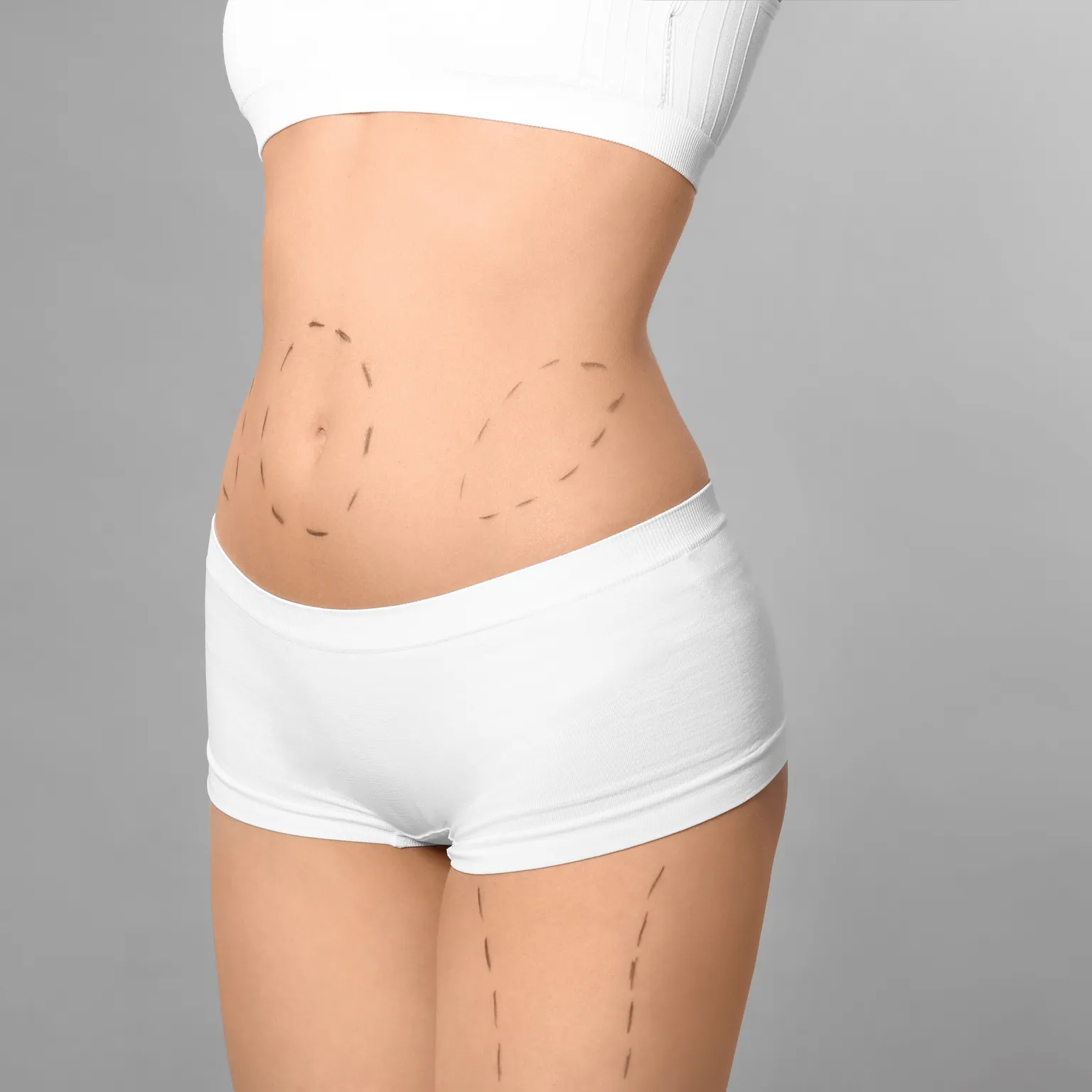
The body is marked while standing, because fat distribution shifts lying down. Markings identify reduction zones, preservation zones and the transitions between them the plan is drawn as a shape, not a set of areas to empty.
- 3
Anaesthesia and tumescent infiltration
Anaesthesia is selected for the extent of the procedure by a dedicated anaesthetist. Tumescent solution is infiltrated into the treatment areas to reduce bleeding and assist fat removal.
- 4
Fat removal and contour refinement
Fat is removed through small access incisions using cannulas, working across the planned zones and repeatedly reassessing symmetry, smoothness and proportion not volume removed.
- 5
Garments, monitoring and recovery
A compression garment is fitted at the end of surgery, followed by staged return to daily activity and then exercise, with the pace set at follow-up. Detailed guidance lives in the liposuction recovery guide.
What results can liposculpture achieve and when
Liposculpture can achieve a more defined waist, smoother transitions between body areas and a contour better proportioned to the individual frame. It cannot change bone structure, produce muscle that has not been developed, or remove skin. Definition is revealed, not manufactured if the muscle is not there, removing fat over it produces hollowing, not shape.
Results appear progressively, because swelling initially masks the new contour. Patients typically notice clothing fitting differently before they see the final shape, and the final result is judged only once swelling has fully resolved and the tissues have settled assessing too early is misleading.
Results are long-lasting but not immune to change: removed fat cells do not regenerate, but remaining fat can enlarge with significant weight gain, and pregnancy and ageing continue for every body. Weight stability is what holds the shape.
Perfect symmetry cannot be guaranteed, because no body is symmetrical before surgery surgery improves balance rather than eliminating asymmetry. Maximum fat removal is never the goal: over-resection is the single most common cause of contour irregularity and an operated-on appearance.
Risks, stated honestly
General surgical risks: bleeding, infection, anaesthesia-related complications, blood clots (deep vein thrombosis, pulmonary embolism), delayed wound healing, and fluid-balance disturbance in larger-volume procedures.
Contour-specific risks: irregularity or rippling, asymmetry, over-correction (hollowing) or under-correction, seroma, temporary or occasionally persistent numbness, skin pigmentation or texture change, fat necrosis, small scars at access sites, and the possible need for revision.
Risk is reduced never eliminated through careful candidate selection, conservative planning, a licensed facility, a qualified surgical and anaesthetic team, nicotine avoidance and structured follow-up. Declining to operate when the risk-benefit balance is unfavourable is part of that process. Read more about how Dr. Augusto Valente approaches patient safety.
What does liposculpture cost in Dubai?
Cost depends on the number and complexity of areas treated, operating time, facility and anaesthesia fees, and whether fat transfer forms part of the plan which is why no single accurate figure can be quoted in advance. You receive a written, itemised quotation at consultation, with no obligation and no same-day pressure.
Why “per area” prices mislead: contour is created across connected zones, not isolated boxes. A quote for “one area” often omits the adjacent zone required for the result to look balanced, and headline prices frequently exclude facility, anaesthesia, garments, tests and follow-up. For what a realistic quote should include, see plastic surgery costs in Dubai.
Seja qual for o profissional que você consultar aqui ou em outro lugar decida com base em evidências, não em marketing. Comece por como escolher um cirurgião plástico em Dubai.
Lipoescultura: perguntas frequentes
Respostas diretas sobre procedimentos, indicação, recuperação e o agendamento da sua consulta com o Dr. Augusto Valente em Dubai.
Is liposculpture the same as liposuction?
Not exactly. Liposuction describes removing localised fat to reduce volume; liposculpture describes removing fat selectively to shape the body, preserving fat in some zones and blending the transitions. Both use the same basic surgical tools the difference is in planning and intent.What does lipoescultura mean?
Lipoescultura is the Portuguese word for liposculpture, used in Brazil and by Portuguese-speaking patients worldwide. It describes the same category of body contouring surgery in another language, not a different operation.Is Brazilian liposculpture a different procedure?
No. “Brazilian liposculpture” refers to a contouring tradition and aesthetic emphasis rather than a standardised, distinct operation. What matters clinically is the individual surgeon’s training and judgement.Is liposculpture the same as a BBL?
No. A BBL specifically involves transferring processed fat to the buttocks, while liposculpture is a broader contouring category that may treat many areas and may not involve fat transfer at all.Does liposculpture always include fat transfer?
No. Some liposculpture plans include processing and transferring removed fat to another area; others involve contouring only. Whether fat transfer is appropriate for your plan is discussed explicitly at consultation.Does liposculpture tighten loose skin?
No. Liposculpture removes fat, not skin. Skin may adapt where elasticity is good, but where laxity is significant, removing fat can make it more visible skin-removing surgery is the relevant assessment instead.Does liposculpture remove visceral fat?
No. It removes subcutaneous fat, the layer between skin and muscle. Visceral fat sits inside the abdominal cavity around the organs, cannot be reached safely by any liposuction technique, and is managed medically rather than surgically.Does liposculpture remove cellulite?
No. Cellulite is caused by fibrous bands tethering the skin to deeper tissue, not by fat volume alone, so removing fat does not reliably improve it and can occasionally make dimpling more noticeable.How is LipoHP® different from liposculpture?
LipoHP® is the specific high-performance methodology created by Dr. Augusto Valente layered deep and superficial sculpting with 360° harmonisation while liposculpture is a general term used differently by different clinics.Can men have liposculpture?
Yes. Male contouring commonly addresses the chest, flanks and abdomen. Where chest fullness is caused by glandular tissue rather than fat, the condition is gynecomastia and requires a different assessment.Can I have liposculpture if I have had liposuction before?
Often yes, but revision contouring is a different operation. Previous surgery leaves scar tissue that makes the fat less uniform and the result harder to predict, so planning is usually more conservative.Does liposculpture leave scars?
It is performed through small access incisions that leave small scars, placed where possible in less visible positions such as skin creases. They mature and fade over time, but no procedure is scar-free.Are liposculpture results permanent?
Results are long-lasting because removed fat cells do not regenerate, but remaining fat cells can enlarge with weight gain, and ageing and pregnancy can alter the contour. Weight stability maintains the result.How much does liposculpture cost in Dubai?
Cost depends on the number and complexity of areas treated, operating time, facility and anaesthesia fees, and whether fat transfer is included. A written, itemised quotation follows consultation.
Quer saber mais? Ver o FAQ completo.